African Growth and Opportunity Act
African Growth and Opportunity Act
Empowering Economic Growth and Partnership
Since its inception in 2000, the African Growth and Opportunity Act (AGOA) has stood as a cornerstone of U.S. economic policy and commercial engagement with Africa. AGOA extends invaluable duty-free access to the U.S. market for over 1,800 products from eligible sub-Saharan African countries, complementing the Generalized System of Preferences program which covers over 5,000 products.
AGOA’s impact is profound, fostering economic growth, encouraging political reform, and fortifying commercial ties between the United States and Africa. To qualify for AGOA benefits, countries must demonstrate a commitment to establishing a market-based economy, upholding the rule of law, promoting political pluralism, and safeguarding human rights and due process. Moreover, they must enact policies aimed at reducing poverty, combating corruption, and facilitating trade and investment with the United States.
In 2024, a total of 32 countries stand eligible to reap the benefits of AGOA. Recognizing its significance, Congress passed legislation in 2015 to modernize and extend the program through 2025, ensuring continued support for economic development and partnership in the region.
Explore Further Resources:
- U.S. Trade Policy in Sub-Saharan Africa: Gain insights into U.S. trade policies and initiatives shaping economic relations with sub-Saharan Africa.
- Sub-Saharan Africa Trade Statistics: Access comprehensive trade statistics to better understand the dynamics of trade between the United States and sub-Saharan Africa.
- U.S-Sub-Saharan Africa Trade: Dive into the details of trade relations between the United States and sub-Saharan Africa, exploring opportunities and challenges.
- AGOA Federal Register Notices: Stay informed about the latest updates and regulatory notices related to AGOA through the Federal Register.
- List of Eligible Countries: Discover the countries eligible for AGOA benefits, facilitating trade and investment opportunities.
- AGOA Biennial Reports: Explore in-depth biennial reports on AGOA's implementation, impact, and future prospects, providing valuable insights for policymakers and stakeholders alike.
AGOA stands as a testament to the enduring partnership between the United States and Africa, fostering economic prosperity, promoting democratic values, and forging stronger ties across the Atlantic.
List of Eligible Countries
AGOA eligible and Ineligible countries
AGOA Eligible Countries
- Angola
- Benin
- Botswana
- Cabo Verde
- Chad
- Comoros
- Republic of the Congo
- Democratic Republic of the Congo
- Cote d’Ivoire
- Djibouti
- Eswatini
- The Gambia
- Ghana
- Guinea-Bissau
- Kenya
- Lesotho
- Liberia
- Madagascar
- Malawi
- Mauritania
- Mauritius
- Mozambique
- Namibia
- Nigeria
- Rwanda (AGOA apparel benefits suspended by POTUS effective July 31, 2018)
- Sao Tome & Principe
- Senegal
- Sierra Leone
- South Africa
- Tanzania
- Togo
- Zambia
Countries Not Eligible for AGOA
- Burundi
- Burkina Faso
- Cameroon
- Central African Republic
- Equatorial Guinea (Graduated from GSP)
- Eritrea
- Ethiopia
- Gabon
- Guinea
- Mali
- Niger
- Seychelles (Graduated from GSP)
- Somalia (First expressed interest in consideration for AGOA eligibility in 2023)
- South Sudan
- Sudan* (Not reviewed for eligibility)
- Uganda
- Zimbabwe
Note: Sudan has not requested designation as AGOA beneficiary countries.
AGOA offers a platform for eligible countries to benefit from duty-free access to the U.S. market, fostering economic growth and development in sub-Saharan Africa.
Trade in Goods Between the United States and Sub-Saharan Africa: 2001-2022
Over the past two decades, trade in goods between the United States and sub-Saharan Africa has witnessed significant growth and evolution. From 2001 to 2022, this trade relationship has played a pivotal role in fostering economic cooperation, promoting development, and strengthening bilateral ties between the two regions.
During this period, trade volumes have surged, driven by a diverse array of products spanning various industries and sectors. From agricultural commodities to manufactured goods, the exchange of goods has facilitated mutually beneficial outcomes for both parties involved.
The data from 2001 through 2022 provides insights into the dynamic nature of this trade relationship, highlighting trends, patterns, and shifts in trade flows over time. Analysis of trade statistics reveals the emergence of new markets, the expansion of existing trade routes, and the diversification of traded goods, reflecting the resilience and adaptability of businesses and economies on both sides of the Atlantic.
As we delve into the intricacies of goods trade between the United States and sub-Saharan Africa, we uncover a narrative of collaboration, innovation, and opportunity. Despite challenges and uncertainties, the trade relationship continues to thrive, serving as a testament to the enduring partnership between the United States and the nations of sub-Saharan Africa.
U.S. Imports under the African Growth and Opportunity Act (AGOA)
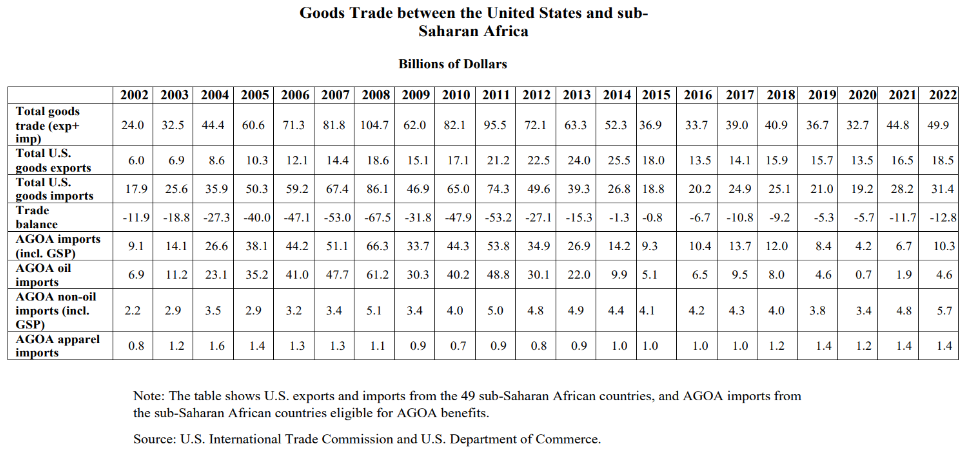
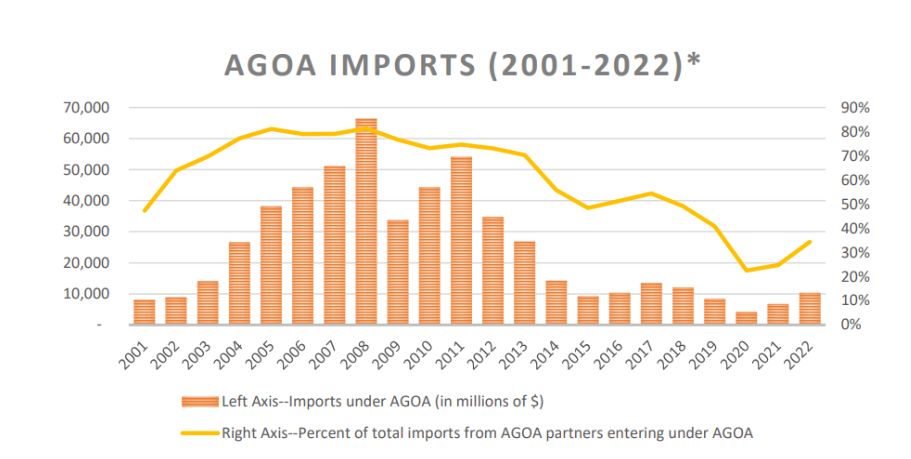
In 2022, imports under the African Growth and Opportunity Act (AGOA), including the Generalized System of Preferences (GSP), totaled $10.3 billion, marking a significant 26 percent increase compared to 2001, the first full year of AGOA trade. This figure remains consistent with the average of $11.6 billion witnessed over the last decade.
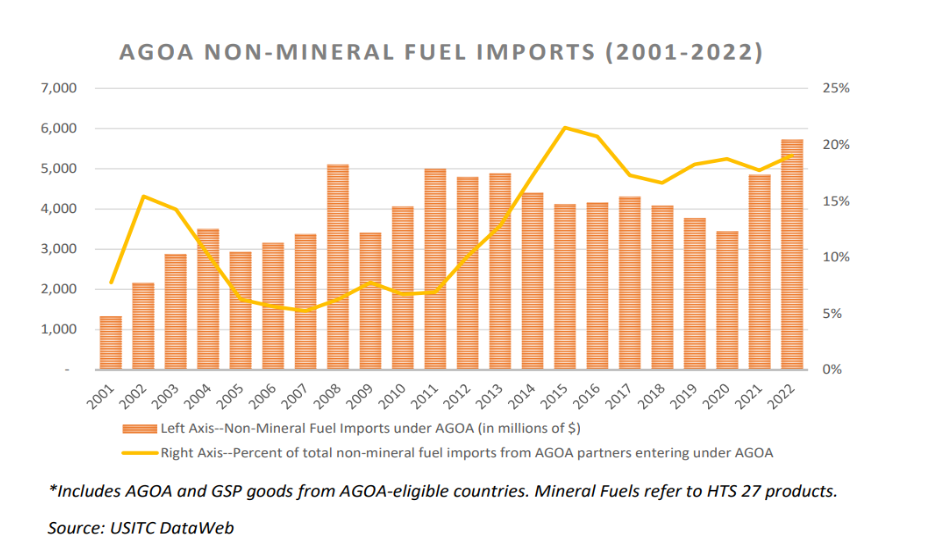
Petroleum products continued to dominate AGOA imports, constituting 45 percent of the overall imports. However, non-oil imports under AGOA reached a record high of $5.7 billion in 2022, quadrupling the amount recorded in 2001. Notably, several non-oil sectors experienced substantial growth during this period, including apparel, auto parts, macadamia nuts, jewelry, fresh oranges, and footwear.
South Africa emerged as the largest beneficiary of AGOA, with imports totaling $3.6 billion, primarily comprising vehicles and parts, fruits, precious metals, and chemicals. Other top AGOA suppliers included Nigeria ($3.5 billion; mostly crude oil), Ghana ($746 million; mostly crude oil), Kenya ($614 million; mostly apparel), Madagascar ($406 million; mostly apparel), and Angola ($391 million; exclusively crude oil).
Additional leading AGOA beneficiaries encompass Lesotho ($260 million; mostly apparel), Cote d’Ivoire ($127 million; mostly cocoa products), Gabon ($125 million; mostly crude oil), Congo-Kinshasa ($92 million; mostly copper ore and products), Tanzania ($75 million; mostly apparel), and Mauritius ($74 million; mostly apparel).
The primary AGOA import categories in 2022 were Mineral Fuels ($4.6 billion), witnessing a substantial 140.0% increase from 2021, followed by Transportation Equipment ($1.5 billion; up 86.4%), Textiles and Apparel ($1.4 billion; down 1.1%), Agricultural Products ($914 million, up 32.9%), Minerals, Metals, and Associated Products ($755 million; down 13.8%), and Jewelry and Precious Stones ($420 million; down 1.1%).
Trade Organization
- World Trade Organization (WTO)
- Asia-Pacific Economic Cooperation (APEC)
- Association of Southeast Asian Nations (ASEAN)
- OECD